





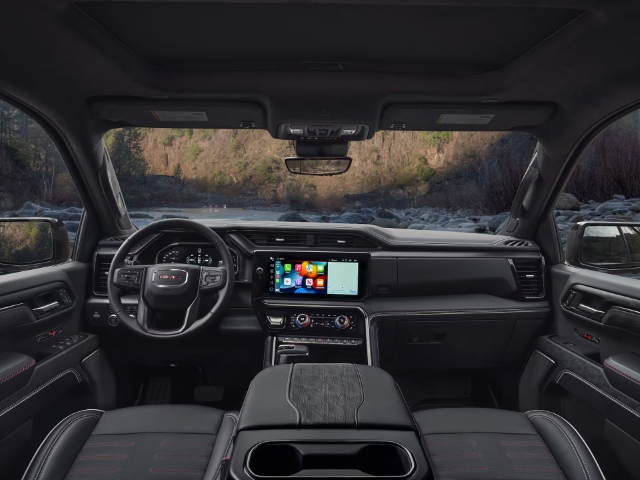
When it comes to the full-size SUV segment, the 2025 GMC Yukon and Chevrolet Tahoe are two standout options that share similarities but also many differences. While the Yukon leans toward luxury, the Tahoe is more focused on value. For Olympia families weighing these options, this guide breaks down exactly what sets these vehicles apart, from pricing to performance, helping you decide which SUV will best fit your Pacific Northwest lifestyle.
2025 Model Year Updates: What’s Changed for Both SUVs
For 2025, the GMC Yukon sports bolder styling with a redesigned front grille, slimmer LED headlights, and animated front and rear lighting elements. Inside, a new, larger 16.8-inch vertical touch screen supports Apple CarPlay and Android Auto. GMC also added new exhaust tips, updated body panels, and optional 24-inch wheels. Several dealer-installed packages are available, from the Elevation Black Package to the Super Cruise & Trailering Package.
The Yukon lineup got reshuffled, too, with the new Elevation model replacing the SLE and SLT trims. The new AT4 Ultimate also joins the lineup, taking the regular AT4’s trail-ready setup but adding massaging front seats and genuine leather throughout all three rows. The Denali Ultimate now offers executive-style second-row seating and a 22-speaker Bose system. Night vision with heat detection is a new feature, helping to spot animals on dark roads, and the diesel engine gets a power boost for the new model year.
The Chevrolet Tahoe receives a mild styling update for 2025, focusing on interior comfort and technology. A new 17.7-inch horizontal touch screen — the biggest in its segment — offers smartphone integration and Google built-in. Several new towing aids make towing easier, while the exterior sports an updated grille and new lighting animations.
2025 GMC Yukon vs. Chevrolet Tahoe: Price and Trim Levels
If you’re looking for value for money, the 2025 Chevrolet Tahoe won’t let you down. It offers a choice of six trims starting at $59,000 for the base LS, then stepping up to the LT at $62,000, the RST at $67,000, the Z71 at $69,000, the Premier at $73,600, and finally the top-tier High Country at $78,700. This range gives you plenty of options, all below six figures. It’s worth noting that the price of the LS is nearly $9,000 cheaper than the least expensive Yukon.
The GMC Yukon offers five luxury-focused trims. Prices start at $67,900 for a two-wheel-drive Elevation and reach $102,500 for the Denali Ultimate. Midrange options include the AT4 ($74,900), the Denali ($78,200), and the AT4 Ultimate ($96,500). The Denali Ultimate costs over $20,000 more than Tahoe’s High Country trim. You can upgrade to the long-wheelbase version, the Yukon XL, across all trims for an additional fee.
2025 GMC Yukon vs. Chevrolet Tahoe: Engine Performance and Capability
Both SUVs offer identical engine options. The base 5.3-liter V-8 produces 355 horsepower and 383 lb-ft of torque, while the upgraded 6.2-liter V-8 delivers 420 horsepower and 460 lb-ft of torque. A revised 3.0-liter turbo-diesel six-cylinder engine generates 305 horsepower and 495 lb-ft of torque, which is now available in the Tahoe’s Z71 trim for the first time. All engines pair with a smooth-shifting 10-speed automatic transmission.
Despite their size, these vehicles move surprisingly quickly. A Yukon Denali with the 6.2-liter V-8 hits 60 mph in 5.9 seconds while a Tahoe High Country with the same engine takes 5.8 seconds to go from 0 to 60 mph. In terms of towing, both vehicles are rated to tow up to 8,400 pounds when properly equipped. That’s more than enough for pulling campers to Mount Rainier or boats to Puget Sound.
2025 GMC Yukon vs. Chevrolet Tahoe: Fuel Economy and Efficiency
At the pump, these SUVs are pretty much neck-and-neck. With the base 5.3-liter V-8 and rear-wheel drive, both vehicles manage 15 mpg in the city and 20 mpg on the highway. Add four-wheel drive, and these numbers dip slightly.
For Olympia families who rack up miles commuting to Seattle or taking road trips to Portland, the diesel engine makes the most sense. It delivers up to 21 mpg in the city and 27 mpg on the highway with rear-wheel drive. That’s pretty impressive for vehicles of this size.
2025 GMC Yukon vs. Chevrolet Tahoe: Interior Design and Comfort Features
Both SUVs share similar dimensions but different priorities. The Tahoe can seat up to nine in the base LS trim, eight in the midrange LT, RST, and Z71 models, and seven in the Premier and High Country versions. The Yukon typically fits eight, dropping to seven in the AT4 Ultimate and Denali Ultimate trims due to their upgraded second-row chairs. Cargo space is virtually identical with 25.5 cubic feet behind the third row, 72.5 cubic feet behind the second row, and roughly 123 cubic feet with all the seats folded flat.
Every Yukon comes with leather seats and heated second-row chairs, while the Tahoe saves its luxury features for higher trims. Yukon Denali models add real wood trim with etched patterns and 16-way power front seats that heat, cool, and massage.
2025 GMC Yukon vs. Chevrolet Tahoe: Technology and Infotainment Systems
The Yukon features a vertical 16.8-inch touch screen while the Tahoe offers a 17.7-inch horizontal screen, the biggest in any full-size SUV. Both offer Google built-in with wireless Apple CarPlay, Android Auto, a Wi-Fi hotspot, Bluetooth, and voice recognition.
A 10-speaker Bose sound system is standard in both SUVs, but music lovers can upgrade to an 18- or 22-speaker setup in the Yukon. Both vehicles include an eight-year OnStar subscription, giving you emergency assistance and app-based remote controls. The Yukon also offers some extra high-tech options, such as rear-seat displays, night vision, trailer cameras for easier towing, and an available 15-inch head-up display that projects information onto your windshield.
2025 GMC Yukon vs. Chevrolet Tahoe: Safety Ratings and Features
Both the Tahoe and the Yukon have earned five-star overall safety ratings from the National Highway Traffic Safety Administration, and you’ll find automatic emergency braking, forward collision warning, lane-keeping assist, blind-spot alerts, and rear cross-traffic alerts as standard across both lineups. Both also offer Super Cruise hands-free driving technology that’s perfect for those long stretches on I-5.
Which Full-Size SUV Reigns Supreme?
Whether you choose the Yukon or the Tahoe will ultimately depend on your budget and priorities. The Chevrolet Tahoe wins on value with its lower prices, making it a smart option for cost-conscious families. The GMC Yukon, however, justifies its higher price with its luxurious features and refined materials making it feel a class above.
Can’t decide? Contact us at Titus-Will Chevrolet GMC to schedule a test-drive of both. Our team knows these vehicles inside and out and can match you with the perfect full-size SUV for your family’s needs and budget.
Connect with us

